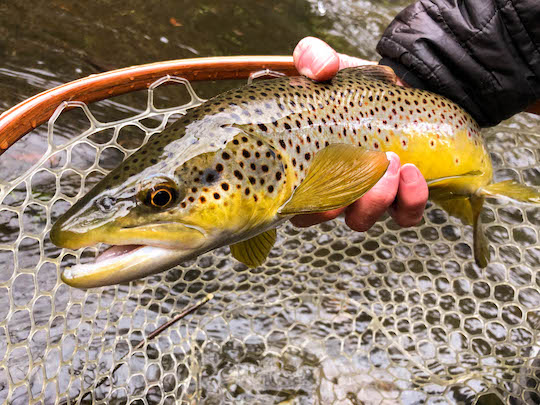
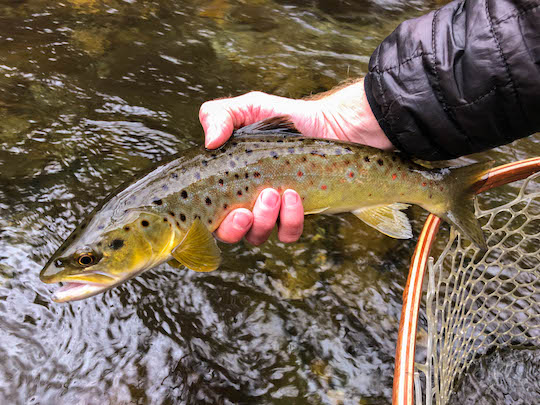
Chasing big trout often involves throwing meat. Big flies, sinking lines, you know the drill. Here in Tennessee, our winter shad kill season provides some of the most exciting fly fishing of the entire year. Big trout gorging on large chunks of protein drifting down the river are even more fun than you can imagine as long as you overlook the often freezing temperatures that produce the best shad kills.
As a fly fishing guide, I look forward to the winter shad kill season for both personal fishing and for guiding. While we catch big fish year round, the winter shad kill season provides some of the best easiest opportunities of the year to catch a great big trout. For those of my clients already in the know, booking their winter fishing is an important part of their yearly fishing. On one of the best trips this past winter, for example, one angler landed 7 brown trout ranging from 18 to 21.5". That is the type of day most of us dream about, but the shad kill makes it attainable for most anglers. Having a good Caney Fork guide helps a lot also of course, but I may be biased.
Anyway, one of my friends/clients had booked a series of guided trips starting in early spring and going through prime fishing season. The idea was to sample a little of everything as many of our clients do. When the day of the first trip approached, I had just experienced the previously mentioned day of catching LOTS of quality browns, so it was an easy decision. We would go to the Caney Fork.
One of the big advantages of being on the water every day is that you see things. If you are paying attention, you'll catch a LOT more fish than if you aren't on the water very often. Thus, the next day, I had a plan of spots I wanted to hit extra hard. As we drifted down the river, I slid the boat into position near a downed tree. For the last couple of weeks prior to this trip, I had seen a huge fish busting shad from time to time. I was hoping John would get a chance. Sure enough, as he drifted through the spot after a perfect cast, the indicator shot down and he came tight to something BIG.
Of course, the first thing the fish did was to run hard upstream towards the tree. I quickly got John to put side pressure downstream on the fish to get it turned, and by some miracle it came out of the wood. Unfortunately, we weren't out danger yet. The fish then dove straight down and nothing John did could slow it down. Suddenly, the line stopped, heavy but unmoving. My concerns were being realized. The fish had taken the bottom fly and the top fly was impaled on a piece of wood somewhere below in the swirling currents. Rowing circles around submerged wood that is between 8-10 feet below on two generators of flow was fun, but I kept at it hoping that the fish would come out and we would still be tight. Alas, it was not meant to be. After trying several angles to get the flies unstuck, I finally instructed John to break it off on purpose. We were both seriously bummed.
The rest of that week I was worried sick. I just knew that a giant brown trout was somehow tethered to the bottom, drowning and unable to throw the fly. As the week came to a close, I had one trip that let me drift past that spot on one generator. Unfortunately, that was still far too much water, and I never saw the wood much less our flies.
The following week, I had two unusual occurrences. First, I was running a very rare Sunday trip. For lots of reasons, my guide service doesn't do weekend trips, but about once or twice a year I make an exception and take someone fishing on a Sunday. Phill had been booked with us last September before health issue crept up that forced him to postpone a long anticipated adventure that included the White River in Arkansas and the Caney Fork River in Tennessee. The second unusual occurrence was that I was guiding a spin angler. As a fly fishing guide first and foremost, it is relatively uncommon for me to run spinning trips. Last year, I ended up running several spin trips, probably more in one year than I had ever run in my entire guide career up until that point. I enjoy spin fishing as it is something different, and I'm very pick with how it is done. It is a nice change of pace although you might not guess I think that when I try to convince you to fly fish instead of using a spinning rod.
Upon booking Phill for a guided trip, as a first time client, we had a long conversation about my requirements to spin fish. Absolutely no live bait and single hook artificial lures only are mandatory if you are fishing with me. Being able to fish effectively with those requirements takes more knowledge, experience, and skill than most think. In fact, I would argue that it takes at least as much skill to effectively fish ultralight gear than it does to fly fish in most generic settings such as drowning nymphs under a strike indicator.
As it turns out, Phill was a very accomplished angler when it came to fishing ultralight gear. He had even fished with a fly rod for a good while at one point in life, but just decided he liked ultralight tackle best. Thus it was that we decided to fish some White River jigs on high flows on Sunday. Our trip went well with several quality fish coming to hand. They topped out a touch over 19 inches which incidentally was about the same size as the largest trout he had caught on the White River in Arkansas. There is a reason the Caney Fork has a reputation for big brown trout.
 |
| "A chunky shad eater." ©2026 David Knapp Photography |
Unfortunately, when I checked the generation schedule, the next morning featured low water. Knowing how much Phill had been enjoying fishing jigs, I was hesitant to even mention what we would be facing. However, upon telling him what it would mean, he actually got excited. "My arm is getting tired fishing these jigs. Let's just fish Trout Magnets," he said. That worked out great for me. I fish Trout Magnets with most of my spin clients and they always catch fish
The next morning, we got just enough water to make a good long drift about two miles down the river fishing jigs, but then it was time to motor back up and change gears. After we got back up and started fishing the falling water, it took a few minutes to get things going. We kept working on the depth and eventually the bites started coming. Then fish started hitting the net one after another. Rainbows, browns, more rainbows, more browns. The Trout Magnet never disappoints.
Phill fishes Trout Magnets back home and wanted to use a specific color that worked well for brown trout in his experience. We were drifting well down the river at this point when I discovered that we were approaching the downed tree and wood pile where John had lost the big brown the week prior. I quickly explained the situation to Phill who graciously said he didn't mind if I took a little of his time to check the brush pile. Sure enough, upon rowing over there, I could see one of my flies stuck tightly to the wood. I tried poking it free with the oar, but it was simply too deep to do much. This was a project that would have to wait for another day. Just as I was about to move the boat back out, I heard Phill say, "I got one!"
 |
| "Fighting a monster brown trout." ©2026 David Knapp Photography |
Looking up, I saw his ultralight spinning rod doubled up. Obviously a big fish, I quickly started instructing him to apply side pressure in a speech that gave me a strange sense of deja vu because of the spot we were fishing. Moving the boat quickly out into the main river, we got lucky when the large trout turned towards the middle of the river and away from the obstructions. Meanwhile, Phill was telling me about the 2 lb test line he was fishing and at some point mentioned that his hook was also barbless. At that, I about freaked out but somehow managed to keep that concern under wraps enough to not affect his focus.
Suddenly, as the big fish turned near the surface and we got our first good look, a saw a flash on its side. Surely not, I thought. As the huge brown got closer and closer, my amazement grew. When the brown trout hit the net, I started whooping and hollering. This was the big brown that John had lost the last week. The fly we had hooked it on was stuck firmly in the trophy brown trout's flank. That explained why we couldn't turn it. Somehow, the fish had hit our fly but the hook didn't stick it in the mouth. Deep nymphing will result in some funny things. The fish had somehow broke off from the other fly (which I had just found wedged in the wood) and had been going about its business as usual for the last week with my fly along for the ride.
 |
| "Trophy Tennessee brown trout on ultralight spinning gear." ©2026 David Knapp Photography |
Pulling the fly out, I quickly put it on a drying patch. That fly might have to be framed. The story on the fly and the fish was just too good. Once pictures were taken, we sat there in disbelief. Me because this fish I had encountered twice in a one week period was okay and swam away strong. I could now rest easy. Phill because the big brown trout he had just gone to the White River to catch actually came out of the Caney Fork River in Tennessee instead.
I knew that John was fishing with guide Pat Tully that day, so we called and told them the story so both could enjoy it. This was by far one of the better fish stories I've been a part of. The fun thing about guiding is that you get to make stories and memories for and with people every day, but this one sure took the cake. On that day, I discovered that there is a whole new level of fishing ultralight than I was used to. Phill was truly great with that gear, and I learned a lot just watching him do his thing. Now, Phill is in the lead for my annual "Guide Trip Fish of the Year" contest. You can learn more about that contest if you are a subscriber to the Trout Zone Anglers email newsletter.
If you want to catch big brown trout on the Caney Fork, feel free to reach out to me for either fly fishing trips or spin fishing trips. I enjoy doing both. I'll always try to tal`k you into fly gear, but if you ask enough times, I'll eventually relent and let you spin fish as well if you follow my guidelines. Trips are always catch and release, no exception.