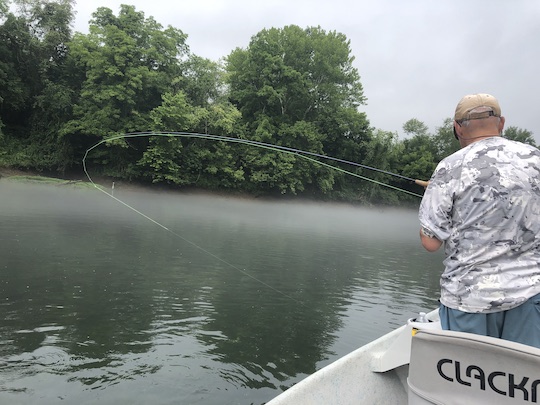
Featured Photo: Morning Reflections

Featured Photo: Morning Reflections

Sunday, August 15, 2021

Chasing Brown Fish on New Rivers

Getting out and sampling a new trout stream is one of my favorite things to do. A new smallmouth river is a very close second. Chasing bronze here in middle and east Tennessee is always a good choice. The smallmouth bass is the state fish after all. Here at the southern end of their native range, smallmouth inhabit a wide variety of waters. From small creeks on the Cumberland Plateau, to larger lowland rivers and lakes, smallmouth are plentiful. With the long growing season, they can also get large. 

Last week, my fellow fly fishing guides Travis Williams and Pat Tully and I had planned on checking out a new to me river that Travis guides on. This was a river I had always wanted to fish, but so far had not made it happen. Ever since Travis got a raft, the possibilities have really opened up. I'm never sure about taking the drift boat down new rivers. A hard boat can get damaged in a hurry. The raft is made for wild and rocky rivers, however.

I was up early after a night of barely being able to sleep. Yes, I still get excited about getting to go fishing. That was good, however, as I had a long drive and needed to leave my house by 5 am. Living just into Central time but regularly commuting into Eastern time zone gets old, but at least I gain that hour back when I come home in the evening. 

When I pulled into the gas station we were supposed to meet at, Travis was already there tinkering with the raft. I quickly topped off my gas tank, and then, when Pat arrived, we headed on to the river. This is a river that has been on my radar for years. Largely because of the history in the area, I have always wanted to fish there. The fact it holds plenty of smallmouth made it even better.

After dropping off the raft, it didn't take long to start floating. We tinkered with a lot of different fly combinations with nymphing seeming to be the right strategy early. Big flies under bobbers are effective at catching smallmouth, but what we really were hoping for was some topwater action. Finally, I couldn't stand it any longer and tied on a popper. We had already caught a few, and I just wanted to catch a couple on the surface.


Sure enough, that proved to be the ticket. We would still try nymphing and streamer fishing in the right places, but the vast majority of the rest of our fish came on top. We got lucky with some cloud cover that kept the fish more active and kept us cooler. By the time the clouds burned off in the afternoon, we had caught plenty of fish and transitioned to pounding the shady banks. 

Pat's big smallmouth. 


All of our best fish came from some type of structure. My big smallmouth jetted out of the stained water and crushed the popper I had on. Same thing for each of us. In the end, my buddy Pat caught big fish of the day while Travis got the biggest spotted bass. I was just happy to be out and catching a big smallmouth on top didn't hurt. 

Travis with one of many spotted bass.


Supposedly, this river also contains musky although we never saw any. I'll definitely be returning in the winter to try that out. In the meantime, I'll be dreaming of summer smallmouth on this new to me river. 

Here is a super short video edit I tossed together with a few clips from the day. For best viewing, click through and view on YouTube. Hope you enjoy!


Sunday, August 08, 2021

Pivotal Moments

Each angler has a growth timeline, and everyone's is different. Most likely, the pattern is not linear, but rather includes growth in fits and starts and maybe even some regression. For example, you probably weren't a proficient caster when you first started into the sport. Over time, you learned a basic cast, then maybe something fancier like a reach cast, parachute cast, steeple cast, well, you get the idea. There is a lot of growth that happens as a fly angler if you are spending much time doing it. 


The Beginning

Most of us started our journey of growth with that first trout on a fly rod. I remember mine just like it was yesterday. My dad had taken me fishing in the Smokies and I was trying my best to figure out how to catch a trout. The shiners were easy, and I had caught plenty of those. Same for the chub and other small minnows. What I wanted was a real, honest to goodness trout. 

We were fishing the lower end of Anthony Creek or the upper end of Abrams Creek depending on your definitions. I generally consider Anthony Creek to be the main stream in the upper part of Cades Cove before the water goes underground and Abrams Creek to be the downstream portion where it reemerges at several large springs. We were fishing just below the road crossing on Sparks Lane. A small cuttbank had helped scour a deeper hole in the creek where the water turned hard. At the bottom, I saw what looked like a rainbow trout. 

Sure enough, after tying on a small nymph, I got the cast angle right and the fly drifted down to the fish. Immediately, the trout inhaled the fly, and I set the hook. Soon, I was holding my first wild rainbow trout. That moment is something I enjoy reliving again and again as a fly fishing guide. Watching people start the journey as a fly angler is one of the treats of my job. Then again, the whole job is more or less a treat.


First Nice Brown Trout

I also remember my first quality brown trout in the Smokies. Not too long after that memorable rainbow, I was back fishing in the Smokies again. My dad was kind enough to take me fishing even though he wasn't himself fishing. These trips were a big treat, and contributed greatly to me being the angler I am today. Without those early trips, I probably would never have become a fly angler, much less been able to make it a career. 

Anyway, it was late in the day. My dad was tired and had stayed up at the car to probably catch a snooze while I wandered down through the woods to the bank of Little River. A perfect run had a big rapid dumping in from above. The big pocket where the rapid dumped in was separated from the main pool, but it looked fishy. I could just imagine the big trout waiting for me there. 

At that point in my angling career, I still was nowhere close to proficient with nymphs. Nowadays, that is probably what I would have been fishing. Thankfully, perhaps, because a big dry fly is what grabbed the attention of the big brown trout. I had tied on a big yellow Stimulator. High sticking it across the first currents and letting it dance across the surface, a big golden blur swirled on it. Once, twice, three times. Surely this fish wasn't going to keep coming back to my fly. And yet it did. One more time was one too many for the fish. 

Down into the big pool went the big fish with me in pursuit. When I finally landed it, I looked around, hoping my dad might appear with a camera. No such luck happened, and I carefully slid the hook out and released the quality trout. The fish was probably 16 inches or so. Nowhere close to the largest I've ever hooked, this was still memorable as the first really nice trout I caught on a fly rod.


First Quality Smokies Rainbow Trout

My first big wild rainbow in the Smokies was also memorable. So was the second. Eventually, some of the big fish you catch over the years start to blur together. However, for me at least, some of those early ones were pivotal moments that gave me the motivation to stick with it. They were evidence that I was slowly but surely figuring things out. 

The first big wild rainbow trout in the Smokies came on Abrams Creek. The late evening hatches and spinner falls are legendary. I found myself there late one day and was fishing over some rising trout. They wouldn't take what I was throwing. About that time, I noticed bugs skittering up and down just above the water's surface. Occasionally, one would bounce all the way down to the water before flying up again. Now I know that I was witnessing egg laying activity. At the time, I just knew I had to mimic the action of the real bugs. 

Extending my rod tip as far out as possible, I bounced it carefully up and down, making my dry fly dance just like the naturals. Sure enough, a big trout leaped and inhaled my fly. The 14 inch wild rainbow was big for the Smokies. I was sure that I was onto something. Catching another couple of fish with a similar technique had me genuinely excited. However, it was a very specific technique with a very specific application. What about when the fish weren't looking for egg layers? 

The second quality rainbow sort of snuck up on me. It was in the fall, and I was fishing a favorite pocket water stretch of Little River. To this day, I still like that section, probably because of the style of water which matches my preferred style of fishing. Regardless, water levels were at a normal fall low and a dry fly seemed appropriate. I had tied some October caddis and had one on the end of my leader as I prospected my way upstream. The take was rather nonchalant, but the fight was anything but. The 15 inch wild rainbow trout gave both me and my fly rod a real workout. I think a couple of cars stopped and took pictures of the fight, but I was too focused to be sure of that part. When that fish came to the net, I had my second wild rainbow over 12 inches ever. 

This second big rainbow was a pivotal moment because I had caught the fish on a rather lengthy cast compared to my usual high sticking. Normally not as successful with longer casts, this moment convinced me that it was possible to catch fish on longer casts. The line management skills necessary would come with practice. 


Fishing With A Guide

My first time fishing with a guide really propelled me forward in my fly fishing journey. In fact, it wouldn't be inaccurate to say that one of the all time biggest contributors to my fly fishing education and growth was thanks to the famous Walter Babb. I wanted to learn to high stick nymphs without an indicator. Today, the buzzword is euro nymphing. Back when I learned, we didn't have fancy indicator tippet, but the techniques are similar. However, the local technique is something that evolved separately, first using a long cane pole and a fixed length line, then eventually a fly rod.

The general idea is to lead the flies through the water without dragging them. When your leader or tippet ticks or straightens out, you have a bite. There are other things like a tuck cast that help make this all come together, but really it isn't too difficult. However, I was having a hard time figuring everything out. The instruction from a professional guide made all the difference in the world, and my catch rates very quickly went through the roof.

My skills in the Smokies were really coming into their own, but there was still a lot of water out there to learn. Tailwaters, smallmouth, and of course trout streams and rivers out west. My horizons were about to expand in a big way and that would further my growth as an angler. 


Sometimes Failure Produces Growth

Interestingly, one of the next major growth moments for me happened almost by accident. Sometimes being in the right place at the right time leads to growth even when you don't catch any fish. This episode happened at Lee's Ferry on the Colorado River below Glen Canyon Dam. After reading about this famous tailwater in Fly Fisherman many years ago, I just had to fish there. When a year off in college took me to Arizona, I knew my opportunity had come. 

I stopped at one of the local fly shops, talked to the person there, and ended up buying some zebra midges. They explained how to fish them, and I headed out to the walk and wade access. In the end, I couldn't buy a trout. The big water of the Colorado both humbled and intimidated me at the time. So, I walked away with some new flies, and a memory of a beautiful river I hope to fish again someday. 

Fast forward a few months, and you would find me standing on the banks of Tennessee's Caney Fork River. As I was thinking about what to fish with, I remembered that somebody had said that Caney Fork was a good midge fishery. Remembering those zebra midges, I dug through my boxes and attached one on a dropper below my dry fly. Amazingly, every fish I cast to ate the zebra midge. To say it was an eye opener would be an understatement. That day on the Caney and that tough day on the Colorado combined to interest me in midge fishing. Now, I fish them year round and am still learning a lot about them each time I go. 

My midge fishing has evolved continuously from that day. I've caught fish all over the western US on midges. Of course, my home rivers also fish well with them. Even in the Smokies, I fish midge patterns when the going gets tough.


Ability is the Sum of Experience and Knowledge

As an angler, there have since been many other learning moments. I'll never forget my first time in a drift boat, with many others to follow. Good friends along the way have helped to mold the angler that I am today. At the end of the day, an angler's ability is the sum of their experience and knowledge with maybe a little luck thrown in for good measure. Certainly some of my favorite catches over the years were the result of luck to some extent. At least being in the right place at the right time, but ability still is an important component. 

Sometimes, an angler can get in their own way too. I've lost a good many fish over the years. There were fish that I shouldn't have lost. Some were my own fault, probably many in fact. Other times, the fish simply won. Still, a good angler minimizes those times through their vast catalogue of experiences. Other battles won and lost. Other big fish played on light tippets, or maybe other big fish on heavy streamers. 

Sometimes even the little guys teach us valuable lessons. I once fished for a 6 inch rainbow in the Smokies for a good 45 minutes without catching it, mostly because I love sight fishing. Still, I learned a lot about what wasn't working on that particular fish. Those big fish are the ones that keep us coming back. I often tell other anglers, both clients and also friends and family, that to land big fish, you usually have to lose a few to figure out how to fight them properly. You can be coached up to a point, yet if guiding has taught me anything, you can be told exactly what is about to happen and still do the wrong thing.


Losing the Bull Trout of a Lifetime

Last summer, on our western road trip, chasing bull trout was part of the goal. I had done my homework. The knowledge piece seemed to be there, but I needed to gain the experience part firsthand. When I hooked and fought a bull trout for probably a minute or more the first day of fishing, I thought I had it made. Seconds later, the fly simply pulled out. 

In retrospect, there were at least a couple of things I did wrong as well as a few I did right. First, I was fishing the heaviest tippet I thought I could get away with. That was smart. Turns out the tippet was the least of my worries. This big mean fish didn't care whether I had tied the fly on with rope. Bull trout are generally going to eat or they aren't. If a bull trout is in the mood to feed, I'm of the opinion that just about anything will work based on my very limited experience. 

Another thing I did right was to bring as much pressure to bear on the fish when it headed for a big log jam. The big fish turned at the last possible second. Another couple of feet and the fish was undoubtedly gone. Unfortunately, I took that lesson and pushed it too far. 

With the fish in open water, I started trying to end the fight immediately. I had my seven weight doubled up. The fish was no more than 15 feet away now. Suddenly, the line simply went limp. In the end, I using too much pressure when it wasn't necessary and ripped the fly out of the bull trout's mouth. I had lost the bull trout of a lifetime up to that point. That isn't saying much since I had never caught one, but the fish was definitely at least a two footer. A really nice fish that I would be thrilled with any day.


Redemption: Lessons Learned and Lessons Applied

A few days later, I finally landed the big bull trout I was looking for. There was chaos in the moment, yet, somehow I did everything mostly correct. At least, I did enough right to land the fish. There were still some stupid mistakes that thankfully didn't cost me. Looking back, I can learn even from those, however. 

The interesting thing about landing a bull trout is the quiet confidence it gave me back on my home waters. You wouldn't think that those things are related. However, losing that big fish on the first day really settled an old lesson once and for all, at least I hope. Knowing exactly how hard to push the fish without losing it is a tough lesson to learn. I'm 99.9% certain I'll eventually have to learn it again. If not on trout, then on some powerful ocean dwelling fish perhaps. 

Still, when I fish the Clinch River now, I find myself far more relaxed and unconcerned when fishing light tippets and small flies. Not that I never lose trout, mind you, but the fish is often more responsible than I am. The funny thing is that my bull trout lesson was on heavy tippet, yet, the real lesson learned was to not panic in the middle of a fight. 

The first bull trout I hooked ended in too much pressure. Often, as an angler, I found that my lost fish come when I panic and do something that I would otherwise know not to do. In other words, fish are lost when you aren't thinking clearly. To land a fish, any fish really but especially big fish, you need to be singularly focused. Blocking out everything but the task before you is tough in our world today. With so many things competing for our time and attention, tossing all the distraction aside and fighting a trout is easier said than done. 

Landing that big bull trout helped me loosen up. For some reason, it was another significant turning point in my fishing career. Now, I don't put as much pressure on myself. More importantly, I don't beat myself up when I lose fish as much as I used to. Let's face it, none of us likes to lose a trout. Yet, putting that moment into the big scheme of things, a lost trout really isn't too important. And that's coming from a guide who knows that landed big fish can be the difference in a big tip or not. Still, at the end of the day, it is just a trout and just a tip. Once you put those things into the proper perspective, you will fish more effortlessly. Not completely effortlessly, just more effortlessly. And each new growth experience will make that a little bit more true. 


Next Growth Moment

The funny thing about those pivotal moments in life, be it in fly fishing or otherwise, you never know when one is about to sneak up on you. In hindsight, they seem pretty obvious, but sometimes it takes a few days at least and often months or even years to realize the significance. The next growth moment could very well sneak up on me. In fact, I've had a couple of moments on the water lately that might end up being important down the road. Right now, I'm still digesting them. Those moments could just be a small blip on the radar. On the other hand, maybe ten years from now I'll write another article like this one and they will be cited as a pivotal moment of growth. 

So what have been your pivotal moments of growth as a fly angler?


Wednesday, July 28, 2021

How To Fight Big Trout On a Fly Rod

Fighting big fish is the eventual goal for most fly anglers unless you've already passed this stage in your fishing career. Some fights last longer than others. I've personally had countless big trout break off on the hook set over the years and probably even more guiding. If you are going to pursue large trout, it comes with the territory. This is particularly true if you choose to target large selective trout on light tackle. Small flies, light tippets, and to a much lesser extent, if you are streamer fishing. I've seen some truly large fish break off on some heavy tippet.

Before we get too far along into this piece, I need to clear one thing up. I'm far from the best person to be telling you how to fight fish. There are plenty of anglers out there who have caught more and larger trout than I have. However, between my own personal fishing and also my guiding, I have learned a few things over the years. I've lost enough big trout to at least be able to tell you what not to do. Some special trout have come along that I've also been fortunate enough to land, and each one of those taught me something as well.


How to Fight Big Trout on a Fly Rod: Rigging

This is an often overlooked part of catching large trout. If your knots don't hold or your tippet is old and brittle, you can have the best fish fighting skills in the world, and you'll still lose most of them. Early in my fly fishing career, I lost a lot of big fish on the hook set. This was due to one or the other of those problems. When tippet snaps, either a knot was bad, the tippet is old, or a combination of both. 

One sneaky problem that is often overlooked in this category is knots combining two types of materials. I routinely use monofilament leaders and add a fluorocarbon tippet. Part of this has to do with me being cheap. However, much more importantly, fluorocarbon has a tendency towards sinking while monofilament has a tendency towards floating. I generally prefer to have most of my leader up on the surface, at least to my dry fly or strike indicator.  Unfortunately, fluorocarbon is much harder than monofilament and often cuts the mono when you attach them together with a knot. 

The first tip here is to use slightly heavier monofilament before tying on the fluorocarbon. For example, if I'm using 6x fluorocarbon for my tippet, I'll generally use 4x monofilament for the leader to the point I tie on the tippet. These can be store bought or hand tied leaders. When you tie the two together, be extremely cautious when seating the knot. Slide the two pieces ever so slowly apart as you pull to tighten the knot. If you are careful, it should be fine. An often better solution here is a tippet ring which eliminates this issue of trying to tie two different materials directly together. However, the tippet ring will want to sink just a bit since it is metal. Thus, it isn't the best approach when you really need to keep that leader on the surface. A bit of mucilin or other paste style floatant can help here.

Another tip on rigging is to use the heaviest line you think you can get away with. Often, if I know I'm targeting large trout, I'll go up to something in the 1x through 4x size range on tippet. Obviously, you probably won't be fishing a #18 midge on 1x, but you might try 5x before going down to 6x. Every little bit of holding power helps. 

Finally, be confident in your knots. I exclusively use a blood knot for tying tippet to leader. That is because I personally tie this knot much better than some of the alternatives and have had the other knots break on me. I rarely tie a bad blood knot and when I do, I was probably joining two different types of materials. Same thing for your tippet to fly knot of course. Always give a little tug after tying a fly one to make sure the knot is good. 

How to Fight Big Trout on a Fly Rod: Gear

Closely related to rigging is making sure you have the right gear. This means reels with a smooth drag (unless you just want to make it harder on yourself) and rods with the right amount of flex. If you are fishing streamers or other applications that allow for larger flies and heavier tippets, then you can get away with a fairly fast (stiff) rod. For light line presentations like smaller dry flies, small nymphs, and midges, then consider something with a bit more flex. 

Protecting light tippets starts with a rod with a tip that isn't too stiff. Big fish break off for a lot of reasons, but usually it comes down to something during the hook set or fight. If you set too hard on a big trout while using 6x and a tiny midge, you better not have a broom stick in your hands.

How to Fight Big Trout on a Fly Rod: The Hook Set

The hooks is another overlooked part of catching big trout. When guiding, I often spend some time literally just practicing the hook set. I'll hold the butt section of the leader or the fly line and have the angler practice setting until I feel like they have the right amount of pressure. Don't have someone around to hold your line? Then tie on a 6x leader to your line, tie the 6x to a dumbbell or something else heavy, and practice setting the hook. The goal is to come tight (that includes putting a bend in your rod) without breaking the small tippet.

I have noticed an interesting problem on the hook set with a lot of anglers. They lift the butt of the rod instead of coming back with the tip. Remember, the whole point here is to come tight to the fish. That means you have to move the rod tip, not the butt of the rod. A good hook set looks a lot like a backcast. The key is knowing when to stop going back. You want to go until your tight to the fish, no more and no less. 

Of course, this only applies to smaller flies or any other application that requires light tippets. If you are streamer fishing, you'll probably have heavy tippet on. In this scenario, we use a strip set. A hard pull or strip with your line hand helps drive the hook home. If you happen to miss the fish, the fly is still in the water and the fish may come back.

A lot of hook sets break off the fish because the angler comes back too far and too hard. This leads us to our next big point. 

Sometimes You Just Have to Lose Some Big Fish

This one is a tough pill to swallow, but the best way to become proficient at hooking and landing big trout is to do it and learn from your mistakes. I routinely tell people that they just need to lose some big fish to get a feel for fighting them. Each fish will teach you something that you can use on the next one. If you lose it on the hook set, then next time you'll know to not set quite as hard. If you lose it during the fight, then you'll learn what not to do there. Of course, sometimes there is nothing you can do if a fish finds the right piece of structure. You'll learn that you sometimes have to put maximum pressure, knowing full well that the fish will either break off or turn before getting in the structure. If the fish gets in the structure, then you will almost certainly lose it. 

Once you have fought a few fish, then you'll begin to have a fairly good idea of where the breaking point is on 4x tippet, 5x tippet, 6x tippet, and so on and so forth. The ability to push a fish right up to the breaking point without crossing that line is what enables you to successfully fight and land large fish without overplaying them. When a client recently landed a monster brown trout, he asked at least a couple of times if he needed to put more pressure on the fish. This ethical dilemma is something that good fish fighting skills will make an easier choice. I've watched people fight a 12 inch trout to exhaustion unnecessarily. I've also watched people land huge trout on light tippet over the course of 10 or 15 minutes and successfully release the trout at the end. Knowing the water conditions (temperature and dissolved oxygen) helps to make this decision, but in the end, good fish fighting skills are necessary to get the fish in the net as quickly as possible.

How To Land Big Trout On a Fly Rod: The Fight

Once you have a successful hook set and that big fish is dancing on the end of your line, then what? As a guide, I always tell people to keep their rod straight up. This is actually not 100% accurate nor always the best strategy, but for people just getting their feet wet in the world of fighting large trout, it is a really good place to start. That is because it is something easy to focus on in the heat of the moment and accomplishes most of what you want to do. However, it would be more accurate to say that you need to keep the rod bent at the appropriate angle, but where is the appropriate angle? 

While holding your fly rod without being hooked up to a fish, the rod is straight. Once you hook that big trout, imagine the rod is still straight and that you want to keep approximately a 90 degree angle between the tip of the rod and the fly line coming from the tip. This allows the rod to flex deeply but appropriately. If you get the rod tip too far behind you and pointing away from the fish, you'll likely end up breaking the rod. If you point the rod at the fish, then the rod can't flex and the fish will either through the fly or break you off.

People often point the rod at the fish because they've seen or heard the advice to bow to fish when they jump. This is great advice, but much better advice, at least for fighting large trout, is to keep low side pressure. Keeping the rod tip low encourages the trout to not jump as much. Low side pressure will generally whip a large fish much faster than the rod overhead technique I often have people use. This is particularly true for large brown trout and much less so for big rainbows in my experience. In fact, if I know I have a big brown trout on, I'll use as much side pressure as possible. With big rainbows, I'll use a lot more overhead pressure.


Whether you point your rod up or to the side, keep the rod at that 90 degree angle to your fly line. This of course doesn't count for the flex of the rod, so the imaginary direct line extending from the handle of the bent rod is the one that should stay at a 90 degree angle to the fish. Whatever you do, don't get the rod pointed anywhere towards the fish. 

As you get tired during the fight, your tendency will be to give the fish room to run by swinging the tip of the rod towards the fish. This is almost always the point where people lose big fish. Once the rod is pointed at the fish, it can no longer bend/flex and absorb the runs and head shakes of the hooked trout. 

When fighting other large fish, this advice is definitely not as accurate. When I fight big striped bass, for example, I fight them with the butt of the rod and keep the rod angled lower towards the fish. When using heavy tippets for larger trout, the same principle applies. You are using the drag on your reel as much as the rod to fight large hot fish. 

How to Fight Big Trout On a Fly Rod: Landing the Fish

If you have done everything right up until this point, there is one more danger point in catching a large trout. More large fish have been lost at the net over the years than anywhere else I'm guessing. A burst of energy always seems to come from nowhere when you go to scoop a big fish. The key is to corral the head first of all. Even if the tail tries to paddle, it will be propelling the fish into the net at that point. 

Don't try to scoop a big fish unless the head is up and under control. Lots of big fish are lost because the fish still has the head down and is ready to run. The introduction of the net at this point will almost certainly cause another big run right when the angler has let his or her guard down expecting things to be over. When in doubt, wait for the next time around. With a big fish, you'll probably only get one shot, so do it right the first time. If you scoop and miss, the chances of bumping the tippet just enough to pop the fly out is really high. 

A long handled landing net is really helpful as is a net with a deep bag. A buddy or even guide is also a big help here but you can do it yourself if necessary. If for some reason you are without a net, then beaching the fish is the next best way to land it. If you choose this approach, make absolutely certain that you choose a spot with plenty of water over the rocks or sand. This is not the time to roll a big fish on dry land. Treat the trout as carefully and gently as possible and grab the meaty part of the tail to subdue the fish quickly.

How To Fight Big Trout On a Fly Rod: The Release

Once you land the fish, keep it in the water as much as possible. That means the head and gills in particular. I've seen a lot of people thinking they are keeping a fish wet, but the part that most desperately needs oxygen is out of the water. Fish should only be out of the water for 5-10 seconds OR LESS for pictures and measurements. So, carry a good net that is big enough for the largest fish you may encounter. There are more tips for handling a trout for catch and release HERE.

The actual release should be taken with care on a big fish. You have just given the fish a major workout and they need time to recover. Hold the fish cradled upright in cold water with some current (but not a rapid). The colder the water, the quicker this process will play out. I will hold the fish carefully for longer than probably necessary until I can barely contain the fish. The trout will definitely let you know when it is ready to go. 

The best part about releasing that trophy catch is the chance to again hook it some day. Our tailwaters here in Tennessee can grow some absolutely enormous trout, but the fish have to be left in the river to grow. People often lament the size of the trout they catch compared to the good old days, all while loading up a stringer with 7 inch stocked trout. The only way those 7 inch stocked trout are going to turn into big fish is if you leave them in the river. While many people choose to harvest and enjoy eating their catch, consider practicing more catch and release if you would like to enjoy better fishing. Imagine a river full of 18-25 inch trout. Most if not all of our tailwaters here in Tennessee could offer that kind of fishing. Until management strategies adjust to make this the goal (not likely unfortunately), then it is up to us as anglers to do the right thing and release our catch.