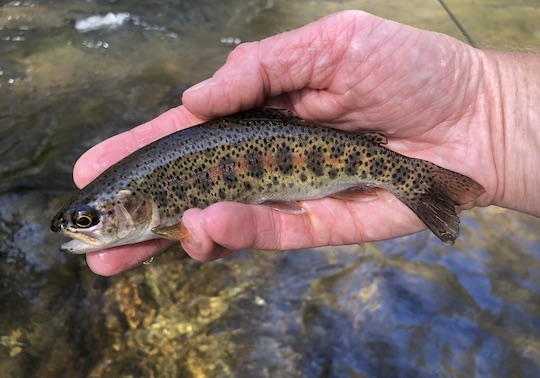
Muskellunge, also known as musky or muskie, is the fish of 10,000 casts, or at least that is the rumor. In my experience, sometimes that is accurate and other times people show up and throw a mere couple hundred casts before catching one. Having the right fly is relatively important, but I'm not convinced it is as crucial as putting in the time. Musky are weird fish. They'll eat when they are good and ready but usually not otherwise. That is, unless you can trigger some instinct. That is just one reason that big streamers can be effective. The fight or flight they can trigger usually doesn't scare something this big and bad. No, a musky will stay and fight. If they feel like it. Or else they'll just stare and wander off, too lazy to do anything about it.
Why Musky Eat Small Meals
Sometimes, instead of big flies, you have to downsize a little. Think about throwing a small snack instead of a big meal. M&Ms instead of a steak. To accurately utilize the advantages that small flies present, you need to consider the life cycle of the muskellunge.
Musky are spring spawning fish. Females and males swim around together and "broadcast" spawn in weedy areas. Those eggs don't take long to incubate and usually hatch within a couple of weeks. The tiny fry grow quickly, going through a list of food sources that are increasingly larger. Once they get "big", favored foods include suckers and other bottom or near bottom feeders, although they are opportunistic enough to eat just about anything. However, even at larger sizes, they still have a memory of those good meals when they were small.
Another way to think about it that many more fly anglers can relate to is this. Brown trout are often considered the perfect species to target while streamer fishing. Their aggressive nature and willingness to chase down and kill smaller bait means they are susceptible to large flies. However, they at least began their life eating bugs just like any other trout, and given the right conditions, they will return to those old habits. A large hatch is often just the right trigger to get large brown trout eating those little snacks again.
Last year, the largest trout I had anyone catch on a guided trip with me (27.25") was a brown trout which ate a small #18 midge pattern fished on 6x. That fish undoubtedly ate sculpins, smaller trout, and the odd mouse or other goodie, but it still went back to the tried and true snacks that were always available every day of the year on this particular tailwater. Musky are no different.
Midge Fishing for Musky
Midging for musky first appeared on my radar during an early musky float. This whole obsession started when I got a call from my good friend and fellow fly fishing guide, David Perry of Southeastern Fly. He had got the bug himself and wondered if I wanted to join on a musky expedition. I still remember that first trip. We didn't see fish most of the trip, but close to the end we did have a small musky flash a streamer that wasn't much smaller than it was. Not far downriver, we saw something else strange. At first, and for a few trips after, I thought that the musky were gulping air much like you will see with gar. Eventually, I started putting a few things together.
These apparently "gulping" fish were exhibiting this behavior almost exclusively during the late hours of evening when swarms of midges were over the water. I don't like to think that I'm slow, but it did take a few times seeing this before the wheels really started turning. Eventually, I finally decided to tie a midge on and the rest is history.
Area anglers have long wondered why we show up to takeout ramps with what appears to be trout rigged rods. In reality, I just like to take advantage of those latent habits that musky still revert to every once in a while. Just like large brown trout will go back to their favorite snacks from their young days, musky will also start eating bugs, even tiny ones. When they start exhibiting this feeding behavior, they will rarely engage with a traditional large musky fly. They become rather selective, focusing on the tiny emerging midges or at other times, caddis, mayflies, or stoneflies. In the summer, hoppers and other terrestrials are important for the same reasons. You'll catch more smaller fish (think 20-35"), simply because they are closer to the time in life that they regularly ate these types of meals, but large fish can be caught on occasion as well using midges.
While I have enjoyed keeping this under my hat, I finally started feeling a little greedy. Finally, one day I was taking a picture of a midge caught musky and realized I couldn't share the picture with the little midge hanging out of its mouth without giving away my long time secret. So, I decided to share the knowledge with the hope that it will help some other anglers unlock the mystery of the fish of 10,000 casts.
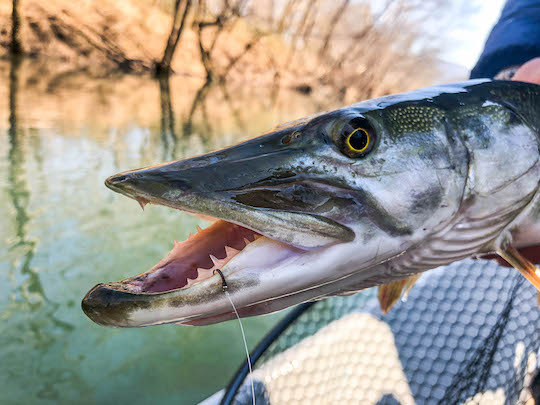 |
| "Midge caught musky for Kendall." ©2022 David Knapp |
Rigging Midges For Musky
Probably the best news I can share is that musky are NOT line shy most of the time. Thus, I use the heaviest fluorocarbon tippet that I can fit through the eye of the little hook. Unfortunately, this doesn't usually end up being very big. Something between 0x and 2x is usually the heaviest that you can get through a #18. The tricky part about this whole thing is getting a good hook set without shredding the tippet on their sharp teeth. Because you really can't use the standard steel or super heavy fluorocarbon on such a small hook, you have to rely on good luck. Thankfully, you usually get enough eats when this fishing is at its peak that you can afford a few break offs. Once the hook sticks in the outside edge of their mouth, the key is to fight carefully and take things easy.
I usually rig just about the same that I would for trout. I prefer hanging a small midge under a tiny strike indicator. When muskellunge are rising to hatching midges, they are normally taking many more bugs just under the surface. A midge pupa pattern will fool most rising musky. I like a pinch of wool for an indicator like the New Zealand strike indicator system. White looks a lot like the bubbles that are also drifting downstream and won't spook fish. While musky are usually not super spooky, they do get cautious when eating bugs since they are sitting high in the water column and visible to areal predators. While eagles, osprey and herons probably can't capture a large adult musky, they will still occasionally try and can leave some serious wounds.
The rod should be fairly stout, because you will be doing battle with a large fish, but you don't want something that is overkill for the flies you are using. I usually go with a 6 or 7 weight rod, but just make sure it has a good sturdy butt section that will allow you to quickly play the fish. Since you are using light tackle, it is imperative that you push the fish hard. It isn't ethical to play a big fish to exhaustion on light tippets, so at some point you'll need to just start pushing hard and hope for the best. That advice applies to playing large trout as well.
A basic floating line on a good quality reel rounds out the setup. Don't forget a large net or musky cradle. Because you are using unusually light gear, a good net will often make the difference between landing the fish or losing it at the last second. Don't forget some forceps or long nose pliers for removing the tiny hook. You don't want to get your fingers too close to the business end of a musky.
A Few Last Tips on Midging for Musky
I don't usually midge for musky except in the cooler months. In the heat of the summer, you don't want to add any extra stress to these fish. If you must fish for them in the warm months, stick to super heavy tippets and get those fish in fast and above all, keep them wet. In the cooler months, water temperatures are not a concern and you can probably do some lighter tippets and smaller flies. If you are out musky fishing and a big hatch starts, look for the tell tale rise forms that first got me started on midging for musky. Once you see them, switch to an imitation of whatever is hatching. You'll be glad you did. Good luck!