Featured Photo: Morning Reflections

Featured Photo: Morning Reflections

Monday, July 26, 2021

An Argument For Catch and Release

If you have followed this blog for any length of time, you probably noticed a period where I blogged about the guided trips I do. However, over time, I realized that I didn't want this blog to become part of my "job," and decided to diligently keep those two things separate. Thus, you have been left with the occasional post about my fishing and anything else that strikes my fancy. Yes, some things are at least motivated by experiences guiding, but for the most part I just use this blog to tell my fishing stories. That was my original motive for starting the blog after all, and what better reason to blog than because I want to remember my fishing trips?

Still, the occasional fishing story from guiding sneaks its way in here. The most recent big guiding event was special enough to merit a place here. However, I want to use it to advocate for something I feel very strongly about: catch and release. When I started guiding, I decided right away that my own personal catch and release ethic would also be part of my business. Trout Zone Anglers is strictly catch and release. End of story. You're more than welcome to write and tell me why I'm so wrong. I've had prospective clients that went elsewhere looking for a guide. In fact, I recommend that they do so if they want to keep fish. You can't pay me enough to take you fishing to harvest a fish. 

Part of this is simple economics. If I let every person who I take fishing keep a limit, all of my good fishing holes would be cleaned out in a hurry. I'm not the world's best guide I'm sure, but my clients tend to catch enough fish to put a dent in the population. If everyone out there was keeping their catch, we would be very low on fish in a hurry. I've noticed that fish populations seem a bit decreased anyway right now in the Smokies, so the last thing they need is additional stressors on their numbers.

Another part of this is also simple. I believe that releasing my catch is the best way to pay forward the moment of awe and beauty that happens every time I connect with a trout. Every fish I put back is a fish that some other angler can appreciate and enjoy, and hopefully, will choose to also release so that, eventually, I might get to enjoy the same fish again myself. 

This brings me to the last piece. I enjoy catching big trout. I really despise seeing big fish on stringers (I honestly believe it is selfish so go ahead and roast me), but I also hate to see small trout being taken because those are the ones that will become big trout someday one way or another. On rivers that I fish like the Caney Fork and Clinch, there are good numbers of fish right up to the top of the protected length range but very few over. Instead of catching lots of fish between 14 and 19 inches, I personally think it would be even better to catch lots of fish between 14 and 24 inches or larger. A minimum size limit on brown trout of 30 inches would gain my instant support. There are rivers and places that have such regulations, and there are reasons they have a tremendous following.

A few days ago, I was able to enjoy first hand the benefits of catch and release. Up until recently, the largest trout that I had ever had a client land was 25.5" and it was a brown trout on the Clinch River. That fish was caught by my good friend and client, Chuck Traylor (#bigfishchuck) on a #20 barbless midge on 6x tippet. We were in the drift boat when the magic happened, and I'll never forget that massive hen brown trout. 

Clinch River Trophy Brown trout
Angler Chuck Traylor with a 25.5" trophy Clinch River brown trout. ©2019 David Knapp Photography


The saying goes something along the lines of lightning never strikes twice, but in my case it did. Fast forward in time to just a few days ago, over a year and a half from Chuck's big trout, and you'll find me yet again drifting down the Clinch River. 

My client this particular day was Bill Cash, an excellent angler from the northeast who is on a mission to fish all of the 50 Best Tailwaters. If you don't have that book yet, then check it out by the way. The Clinch River was going to be number 25 on his quest. By some stroke of fortune on my end, I got the call to share the river with him. Some anglers don't really need guides, but they enjoy having someone show them the ropes and shorten the learning curve on new water. Right away, I figured out that Bill was one of those anglers. His casting was very good and fish fighting skills were on point. He would need those skills early on this day. 

We hadn't been drifting very long when the indicator twitched then briefly dipped. He set the hook, but for some reason it didn't stick. That turned out to be a very good thing. Seriously though, when was the last time you were thankful for missing a fish? Not too often I'm guessing. After the recast, we drifted a very short distance downstream when the indicator went down convincingly. This time, there was some weight on the other end. 

Having guided for quite a few years and fished even longer on the Clinch, I was expecting a standard operating model. That would be a rainbow trout somewhere in the 15-18 inch range and probably hot. The fish would likely jump or at least roll on the surface. Initially, things seemed to progress right on schedule. The fish made a hard run from right to left across the front of the boat. I noticed right away that Bill was keeping appropriate side pressure and letting the fish run when it wanted to. Things got interesting, however, when he absolutely could not turn the fish.

When I asked about the fish, he said it was a pretty good fish, probably 18-20 inches. That's a good way to start the day. Then he said something that had me wondering. "It is a brown trout." Okay, so not what I was expecting after all. A brown trout would explain the digging for the bottom and head shakes, however.  Eventually, the fish made it close enough to the boat for me to get a glimpse. I was convinced of the brown trout diagnosis and also began to think the fish might be a little larger, maybe in the 22" range. 

With 6x tippet to both flies and our largest offering a #18 midge, I advised him to not push the fish too hard. The water was ice cold and well oxygenated from the early morning generation pulse. This fish was going to be fine. At this point, Bill was totally focused and putting on a clinic when it comes to fighting large trout. Low side pressure and pushing the 6x to just short of the breaking point was a recipe for success. 

When the fish started a hard upstream run, I realized we would have to pursue. Getting the oars going, we gave chase. This fish eventually took us up and down but apparently it wanted to stay on its home turf and never went too far up or downstream. A couple of times it got dangerously close to some logs, but by some miracle, it stayed out of the structure for us. 

The fish came boat side but was staying deep. I contemplated deep netting the fish, something I've done on big brown trout before. When I stuck the big Fishpond boat net in the water near the fish, I realized something important. The fish was at least as long as the 25" opening on my net hoop. A mistake trying to dredge the fish up with the net would almost guarantee losing this monster. We were going to have to get the big trout's head up before making the scoop. 

Again, out of an abundance of caution, Bill asked if he needed to put more pressure on the fish. I reassured him that he was fine. Any more pressure and that fish was going to be gone. Finally, the fish began wearing down. Another blistering run back downstream got us closer and closer to landing the beast. Finally, the big trout began coming to the surface. Bill was putting enough pressure on the fish that I was nervous. Still, we had to get this fish up somehow. When it rolled near the boat, I was ready or so I thought. What I hadn't counted on was how big this fish was. Even larger than it had looked at depth, this fish was a true fish of a lifetime. The net barely contained the big hen brown trout. I quickly handed the net off to Bill and asked him to keep the trout's head submerged while I got the boat situated. Then we ascertained the situation and got the necessary pictures. 

When we put the trout on the tape, it stretched to 27.25", a true monster and the largest I've had the good fortune to see on my boat so far. The pictures were done quickly, and within about 10 seconds we had the fish back in the cold water. I had jumped out of the boat as soon as the anchor was down and wasn't taking any chances on the health of this fish. We kept her cradled upright and revived her carefully. Finally, with several powerful thrusts of her tail, she sped off back to the depths. 

Then we just sat there and soaked up the moment. Both of us realized that we had reached the pinnacle of the day early. This big brown trout would almost certainly be the largest fish of the day. Once we started fishing again, we began drifting though the same area where the big brown trout had been caught. On our second pass through this area, I noticed a dark shadow shoot under the boat and settle into a large depression not far away. Upon closer inspection, I realized it was the big brown trout that we had released well across the river and upstream. She was back almost exactly where we had caught her already which told me she was going to be fine. 

The rest of the day featured good fishing although it was largely anticlimactic. We caught plenty of rainbow trout up to about 19 inches with the smallest being around 13 inches. No more browns showed up though. Interestingly, a lot of brown trout were stocked early this year. I saw them leaving the river by the stringer load. I don't know what in the world people are going to do with a bunch of 7 inch trout. Personally, I would rather see them stay in the river. We had just witnessed what the Clinch River is capable of producing if the fish are just left in the river to grow. Most of our tailwaters could be full of 16-24 inch trout if people would just release their catch. I for one wish that more anglers would choose this strategy with the long term goal of catching more and larger trout. 

The moment this point was driven home was when I texted Chuck a picture of the big fish later in the day. Not too long after, he responded by mentioning that he thought it was the same trout he had caught a year and a half ago. If so, the fish had grown by 1.75 inches. That is pretty good for such a large brown trout. When they are younger, they can grow much faster. These old big fish grown much heavier but the length doesn't come as quickly. 

When I got home, I checked up on what Chuck had told me. Sure enough, by comparing the spotting on both fish, I realized this was the exact same trout that Chuck had caught before. If he hadn't of released his catch a year and a half ago, then Bill and I wouldn't have had this amazing experience. Thankfully, Bill also released this magnificent fish. I just hope that any other anglers who happen across this fish will do the same thing. Maybe, just maybe, in another couple of years we'll catch her again, and she'll be 30 inches the next time. 

Trophy Brown trout on the Clinch River
Angler Bill Cash with a 27.25" trophy brown trout on the Clinch River. ©2021 David Knapp Photography


Wednesday, July 21, 2021

Summer Smallmouth Pilgrimage

There was a time that I would fish for smallmouth several times a year. In fact, some years I probably managed 8-10 trips. As I've become busier and busier with guiding, my discretionary fishing time has suffered as a result. Not that I'm complaining mind you. I'm blessed to have the business I do and enjoy watching my wonderful clients catch fish. Still, you do start missing some of your favorite fishing spots when you don't visit them too often. 

Recently, I had planned to go fishing for smallmouth bass with a friend from out of town. Plans were made, flies were tied, and I was excited to hit the water. When something unexpectedly came up and he was no longer able to join me, I decided to go anyway. I'm glad I did. 

The access point was about as sketchy as ever. I'm always rather cautious about leaving vehicles parked at trailheads and other access points, but more so in some places than others. My usual routine for the smallmouth bass streams is to make sure that there is nothing valuable in my car or truck. I only carry whatever rod I'm fishing for that day. Thus, if someone happens to break in, I haven't lost any valuable rods. The obvious downside here is that if a rod gets broken, there are no backup options.

Walking into this stream always reminds me of fishing in the Smokies. Rhododendron and mountain laurel are thick in the gorges that the smallmouth call home near me. Once you get to the stream, however, you realize that these are altogether different than fishing in the Smokies. Personally, I think the Plateau streams are more rugged and also more unforgiving. You have to be careful when fishing these creeks. If something goes wrong in the Smokies, someone will probably be along fairly soon. Here on the Plateau, it could be a day or three weeks before someone else shows up. We have the same potential hazards here on the Plateau except in greater volume. 

The ticks in particular can be bad, so I prefer to get into the stream bed and stay there. For that reason, I carry a Fishpond waterproof backpack instead of my usual waist pack. The hassle involved with changing flies or getting out my water bottle is worth the ability to swim the larger pools instead of getting out on the rocky and brushy banks. I've seen enough copperheads and rattlesnakes that my motivation for staying off of those banks goes beyond the ticks. 

Still, the fishing is close by and the fish are usually willing. On a really good day, the fish will top out in the 16-20 inch range. There aren't as much truly gargantuan smallmouth bass as there are on the lowland rivers, but there also isn't the number of people fishing for them. Everything is a tradeoff, and I would rather have solitude any day. This turned into the first fishing trip I've had in a while where I didn't see another person. No swimmers, no anglers, no hikers. Just me, the fish, and the stream. 

The strange thing on this trip was the lack of big fish. As I just mentioned, big fish here means mid to high teens in length. I only saw a couple of fish that might qualify by those standards. Normally I see several more. Still, the fish that were there were hungry and willing. By the time my day was over, it was probably one of the best smallmouth bass fishing trips I've ever had for numbers. Lots of those fish were caught on the surface, but I caught plenty subsurface as well. 

This trip was a fun one because I explored new water. My usual direction to fish on this stream was there and inviting, but I decided to head down instead of up. Maybe that's why I didn't see big fish. They all hang out upstream. Really, the water was good enough that I don't think that is the answer. Maybe there are more people fishing downstream instead of upstream. The last year has been difficult on fish populations everywhere. With the COVID pandemic, more people than ever have been fishing. With populations exploding and more and more people recreating outdoors, the numbers just don't add up in favor of the fish. At some point, over-harvest will become a serious problem if we aren't there already. If every angler caught and took their limit of fish, there simply wouldn't be enough fish to go around. 

A more likely scenario than over-harvest (on this stream at least) involves poor recruitment from some recent years, limiting some age classes of fish. The three or four years of high precipitation is starting to take its toll on fish populations around our area. Thankfully, based on the numbers of smaller fish, it looks like the future is still bright.

Upon reaching the stream, I worked quickly downstream through an area that normally holds some better fish. I got the first fish on the board (a chunky bream) along with the second (a little smallmouth), but nothing of any size. 


Moving downstream through some shallow riffles, a small slot produced another smallmouth. The next set of riffles led into the first BIG pool of the day. 

These large pools hold all kinds of fish. This one had the usual assortment of redhorse cruising around the head. Since I was looking for smallmouth, I quickly passed them by and started working the much deeper water just downstream. A smallmouth bass attacked my fly, but again the size left me looking for more.


Despite their small stature, the bass so far on this day had all been hard fighters. The water was low enough that they were rather timid. Casts had to be long and accurate. This might have been the lowest I've ever fished this particular river, but not by much. It was somewhat hard to judge since I was on new to me water as I worked downstream.

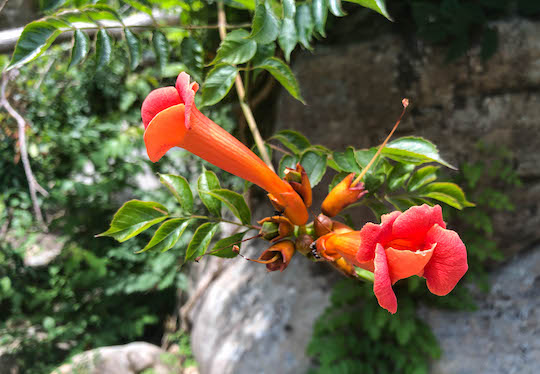
The wildflowers were better than I expected on this particular trip. I always forget about some of the summer flowers that I enjoy. Some new ones also caught my eye, or at least ones I hadn't stopped to really notice before. American water willow (1st picture) in particular caught my eye along with a Carolina wild petunia (2nd picture). I also found a great example of trumpet vine and snapped a picture (3rd picture).

American Water Willow
American water willow. ©2021 David Knapp Photography

Carolina Wild Petunia
Carolina wild petunia. ©2021 David Knapp Photography

trumpet vine or trumpet creeper
Trumpet vine. ©2021 David Knapp Photography


These gorges never cease to amaze me. Huge sandstone boulders that broke off from the caprock of the Cumberland Plateau have tumbled down the slopes and into the water's edge. In places, piles of these boulders construct the flow, bringing a stream that averages 40-80 feet across down to just 10 feet. At high water levels, these become the huge whitewater features that paddlers come from all over to experience. Since I'm not into whitewater, I haven't seen it when the water gets big. What I do know is that the best whitewater features are also some of the best bass water.

My favorite technique is a long line technique with a sinking fly that I think they take as a crawdad. I let the fly sink down out of sight and watch the leader. If it ticks or jerks, I set the hook. Eventually, I'll start twitching and stripping the fly back if there isn't a strike on the original drop. If the water was a little higher, a deep nymph rig would work like a charm, but these streams are tough to navigate even on low water. If the water levels were good for nymphing, it would be almost impossible to wade. 

As I worked through the narrowest pools of the day, I was amazed as always at how big the rocks along the banks are. Most were way larger than my truck. At least a few were probably nearly as large as my house. This panorama doesn't do any justice, but just know those boulders are all between those two sizes I just mentioned. 


Just downstream from here, I was starting to get tired enough to think about turning around and heading home. Lunch on a rock seemed like a good idea. A hummus wrap (tomato/basil wrap, hummus, spinach, cucumber, bell pepper, and feta cheese) along with a few chips and fresh sweet dark cherries hit the spot. My water had warmed a little in the backpack but was still cool enough to wash everything down with. As I ate, some sunfish played nearly at my feet. I thought about throwing a fly at them, but decided they were more fun to just watch. 

 
Lunch with a view. ©2021 David Knapp Photography


After eating, I started the long slog back up to my "out" spot. Most of the access to these gorge fisheries is difficult to nearly impossible. Once you have a good access point, use it. Don't try to blaze a new path. Trust me. The ticks, chiggers, rattlesnakes, and copperheads will teach the lesson the hard way if you do. 

As I fished back upstream, I put a big hopper back on to try and find a few fish on the surface. I had started the day on top, but had finally switched to a subsurface fly in the big dark pool about halfway down. Now, I was in a better position to fish the topwater fly. Bass were holding in the shallow tailouts and deeper slots facing upstream just like trout. As I waded, I moved slowly and carefully, trying to think like the great blue herons that always seem to out fish me. One misstep would send smallies running in every direction. However, a well executed cast would get an eat as often as not.


I continued moving, but my feet were itching to go home so I moved faster and faster. One final memory was to be had, however. A nice shallow run amongst an otherwise featureless flat had contained some fish on the way down. Now I was in better position to fish it, however. I made a cast way out in the middle and bass came running from all over to see what the commotion was about. One better fish finally ate and the battle was on. Finally, a better fish. This wasn't nearly as large as some I've caught on this stream, but it was the big fish for the day. I saw a couple that would have been larger, but they were smarter than me on this day.


Reaching my exit point, I climbed out and scurried up the bank so I didn't linger near the stream side vegetation. I've seen way too many ticks on this stream before to waste any time. I made the hike back up the hill to my truck and was thankful as always to find it still there and intact. The air conditioning was going to feel good...

Sunday, July 18, 2021

Backcountry Jaunts

Sometimes you just want to have the stream to yourself. Around here, that usually means a hike and the longer the better. On some of our smallmouth bass streams, those hikes don't have to be as far. Those streams rugged nature and difficult fishing means that they aren't buried in people like some trout rivers are. On the other hand, if you head to the Clinch River on a weekend morning, you better bring your own rock to stand on. 

The Great Smoky Mountains fall somewhere between these two extremes, although on some days it can feel awfully crowded these days. Not all that many years ago, you could fish just about wherever you wanted to most of the year. Those days are long gone or at least on an extended pause. Thus, if you want some semblance of a backcountry fishing experience, you better plan on walking. 

A couple of weeks ago, my buddy and fellow fly fishing guide Pat Tully and I trekked into the Smoky Mountain backcountry for a few hours of fishing. This wasn't the longest hike I've ever done to fish in the Smokies, not even close in fact. However, at over four miles, we were far enough into the backcountry to have rather high expectations. As we finally broke through the brush that separates the trail and stream, we were filled with anticipation of a good day ahead. Crimson bee balm brightened the scene even further.


I was already rigged and ready while my buddy Pat still had that task to do. Thus, I quickly eased into the first pool and made a few casts. A couple of wild rainbows inspected the fly, but overall they were surprisingly skittish. Or maybe I should have said suspiciously skittish. Backcountry trout are supposed to be pushovers. That's why we go to all this effort anyway. Still, the day was young and my expectations high. Moving up to the next pocket, I didn't expect much since it was fairly small. When I was greeted with no fish, I just assumed it was too small of a spot.

The third pocket had some potential but was also smack dab in the middle of a big sunny patch. When I drifted my flies through just right, one quality fish made a beeline for my flies before backpedaling and disappearing in the direction it had approached from. Things were definitely looking strange. 

By this time, Pat was rigged and ready so we started to leapfrog. Somewhere around this time, I finally got a small rainbow on my dropper nymph. Then, as I was sneaking past Pat to get to the next spot without spooking his fish, I saw my first clue in the form of water drops on the rocks. Paying careful attention, I found a few more. This was a person (or creature anyway) that knew how to move in water. The tracks were not obvious nor definitive. They could have just as easily been an otter as a human. Still, between the shy trout and the marks on the rocks, I was convinced we needed to adjust.

After consultation with Pat, we decided that the thing to do was to move to another nearby stream. That is always a good choice when it is feasible. We were lucky to be in an area with so much water. A short walk put us on some different water. While it wasn't fast and furious, we were soon finding enough fish to confirm our decision as the correct one.

Backcountry streams in the Smokies all fish similarly but each with its own unique character. These particular streams both have long sections of flatter water with some really great quality plunge pools mixed in. The flatter water is conducive to the occasional brown trout, but the majority of the residents are rainbows. Brook trout also turn up from time to time, becoming more numerous not more than a mile or two upstream from where we were fishing. On this day, I was destined to catch just rainbows, but some of them were memorable. 

We appear to be in the middle of another big fish cycle. Maybe not as much on the brown trout, but definitely on the rainbows and maybe brook trout as well. This is due in no small part to the multi year high annual precipitation event we've had for the last 3.5 or 4 years now. We have lost at least the majority of two age classes for the brown and brook trout due to high flows in the fall and winter. Rainbows have been impacted to at least some extent. The benefit is that we are now seeing some better than average fish. this is part of the natural ebb and flow of life on these streams. Some years the numbers are through the roof, but fish seem to average 5-7 inches. Other years the numbers seem slightly impacted, but the average size is a legitimate 8 or 9 inches.

The fishing was good but somewhere short of phenomenal. Those rare days where every fish seems to be eating any fly on the first cast don't come along too often, but on this day, fish would at least eat if the drift was right and you showed it to them a few times. In fact, I was surprised at how many drifts it took in some pools. 

One particularly good hole was producing lots of hits, but few hookups. I have always caught several fish in this pool and expected no less on this day. My buddy Pat was somewhere just downstream, so I had time to relax and really work the pool. My first several casts produced strikes but no fish. Yes, everyone misses fish on occasion but this is especially true in the Smokies. Eventually, I finally hooked one and realized the problem had been as much the small size of the 5 inch trout. Those little ones eat and also spit the hook back out the fastest making them tougher to hook than the nicer trout. 


Slowly I worked into the head of the pool. Throwing my dry/dropper rig right into the fastest water started yielding more promising takes. I think it was after the second or third trout to hand that the nice fish came up and all but ate my dry fly. Realizing that it was a trout I really wanted to hook, I settled down to show it as many different angles as possible. Finally, several casts later, it happened with the dry fly diving hard into the current. When I set the hook, I was attached to the big fish of the pool. Big on these streams usually means 8-10 inches. 

The fight was fairly short lived. Soon I was admiring a gorgeous wild rainbow that was clearly the top of the pecking order in this pool. I let the rainbow rest in my net while I fished the cellphone out of my pocket. A quick picture and the fish was back swimming in the pool again. These fish are too special to harvest, so all of mine go back.


Right as I looked up again, I noticed something interesting. Way over on the right side of the pool was a small current that curled around some rocks and over a shallow, rocky bottom before rejoining the main flow in the middle of the pool. It was the sort of spot I would generally ignore, especially with the bright sun overhead. Still, what I had seen was definitely a rise, and I'm a sucker for rising trout.

I worked some line back out and made the long cast and a quick mend upstream since I was fishing up and across the current. The correct move would have been to carefully cross the stream and fish from the right side, but I'm always up for a challenge. Right before the line started to drag in the middle of the pool, the dry fly slowly sucked under. I knew it had to be the rocks on the bottom, but out of habit, I set the hook anyway. This was one of those times that I was probably more surprised than the fish on the other end as a gorgeous rainbow exploded out of the water. 

I quickly fought the trout and repeated the process from the previous trout. In the net, rest, a quick picture, then back into the water to enjoy another day. Neither fish was out of the water more than a few seconds. Both will be healthy and there when I return unless someone else harvests them.


At this point, we had probably been fishing a grand total of an hour or so between the two streams. Certainly no more than an hour and a half. I was getting antsy though. With a newborn at home, I've been finding more and more excuses to get home fast at the end of a day. We continued leapfrogging upstream, but I had already caught my fish and was thinking more and more about getting back home. At this point, I was enjoying watching Pat catch fish as much or more than catching them myself. One particularly nice fish had me asking for a picture and he obliged. 


Finally, after one last really nice pool, I decided to take my leave. Pat was planning on fishing a little longer, so we parted ways, and I hit the trail for the hour walk back out. Getting back home in time to fix supper and relax was nice on my day off.


Lately, I've been getting the itch for another backcountry jaunt, perhaps with the backpack and making it an overnight. Then again, I might just spend more time at home. Either way, I enjoyed this opportunity to get into the Smoky Mountains backcountry for myself that is becoming rarer these days. Hopefully it will happen again soon!